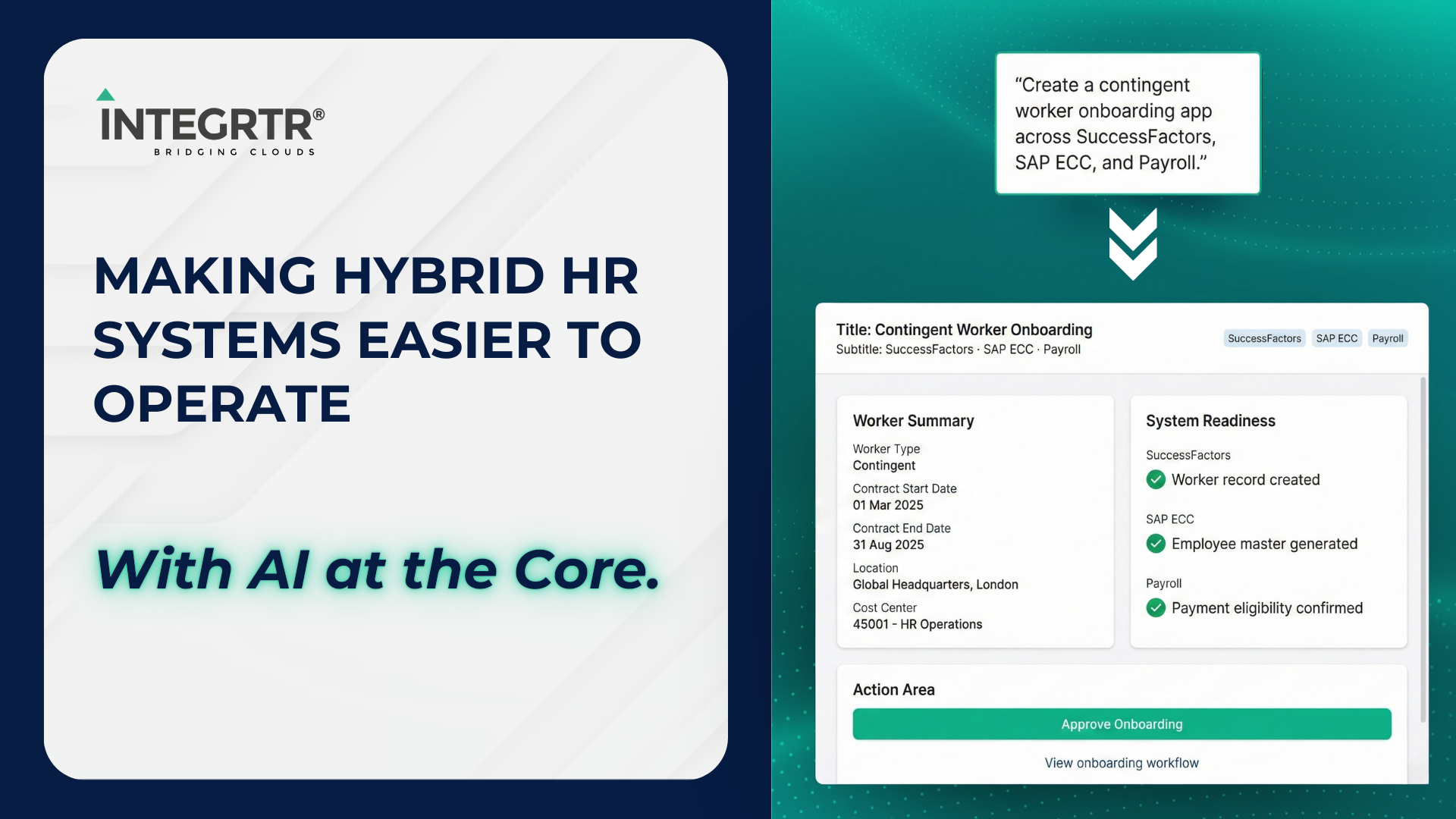





If you run a global HR landscape, most of your time is not spent on transformation.
It is spent translating intent into execution.
A business stakeholder asks a simple question.
You know the answer exists somewhere in the system.
But getting to it still means navigating multiple tools, validating assumptions, checking documentation, interpreting logs, and often looping in the right expert.
The systems work. The integrations work. What does not work is the distance between a question and an outcome.
And in hybrid HR landscapes built around SAP SuccessFactors, SAP HCM, Workday, payroll systems like ADP or UKG, and platforms such as ServiceNow, Coupa, or Snowflake, that distance adds up quickly.
What Are AI-Powered SAP SuccessFactors Operations?
AI-powered SAP SuccessFactors operations refers to using embedded, system-aware AI to explain configurations, analyze RBPs, interpret integration errors, compare environments, and execute mass data changes directly within the HR operations platform, with full auditability and traceability.
SAP has introduced Joule to assist users inside SuccessFactors with contextual, in-product guidance. That support is valuable.
INTEGRTR’s focus is different.
Our AI is designed to operate and execute across hybrid HR landscapes, where configuration, data, integrations, and governance span SuccessFactors, SAP HCM, payroll systems, and third-party platforms.
Hybrid HR Landscapes Are (Mostly) Stable. The Effort Is (Definitely) Not.
Most large enterprises have accepted a simple reality: their HR landscape will remain hybrid for the foreseeable future.
SAP HCM continues to run payroll in many regions.
SAP SuccessFactors / Workday owns core HR and may power recruiting or talent where as payroll may reside in local systems like ADP or UKG, and platforms such as ServiceNow, Coupa, or Snowflake.
Around this sit integrations, identity systems, local payroll tools, and compliance-driven extensions.
This setup is not broken. In fact, it is often the most pragmatic and resilient choice.
What is broken is how much manual effort is still required to operate HR/SAP SuccessFactors operations day to day.
Where HR-IT Time Is Actually Lost
The biggest drain on HR-IT teams is rarely large transformation programs.
It is the constant stream of operational questions that surface during everyday SuccessFactors administration:
- Why did yesterday’s replication fail?
- What changed between Test and Production?
- Which RBP update triggered a downstream payroll issue?
- Is this MDF field actually upsertable?
- Where is this logic implemented?
- Who last touched this configuration?
Every one of these questions is answerable today, but answering them still requires translation.
Translation between:
- business questions and technical reality (from deciphering SLG1 logs to tracing BIB mappings and replication behavior)
- intent and OData queries
- configuration and documentation
- data changes and execution tools
This is where AI for SuccessFactors configuration management becomes relevant.
The problem is not missing functionality. It is fragmentation of context.
When a Platform Truly Understands HR Data
INTEGRTR was built around a demanding premise:
if a platform deeply understands HR data models, it can automate far more than integrations alone.
Today, customers already use the INTEGRTR Platform to:
- define and manage complex HR system landscapes
- generate, correct, and validate mass HR data in SAP SuccessFactors
- work with hybrid data models across SAP SuccessFactors and SAP HCM
- compare configurations across environments
- maintain system documentation and audit evidence
- run and monitor critical integrations
These capabilities already address problems like automated SuccessFactors documentation, configuration drift, and audit readiness.
They are grounded in real HR complexity: effective dating, MDF dependencies, event handling, permission structures, replication logic, and country-specific constraints.
Once a platform reaches this level of maturity, a new limitation becomes obvious.
The Limitation Is No Longer Capability, It’s Access
At that point, the bottleneck is no longer what the platform can do.
It is how users interact with it.
Most HR-IT work still starts with intent:
- “Explain why this replication failed.”
- “What changed in Production after the last transport?”
- “Which RBPs introduce security risk?”
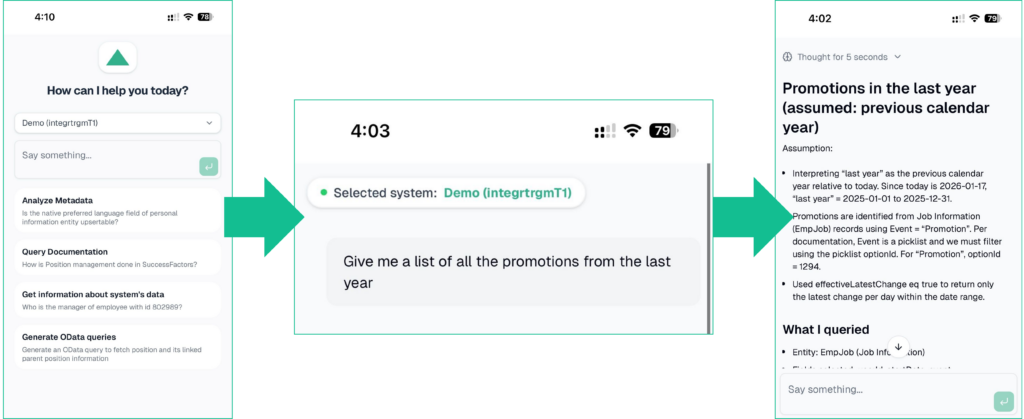
- “Generate the OData query for Position and Parent Position.”
- “Show me all promotions from last year.”
These are exactly the kinds of questions teams ask when they need to troubleshoot SuccessFactors replication errors or validate system behavior quickly.
Today, intent still has to be translated:
intent → tool → configuration → query → validation → execution
That translation is where time, confidence, and consistency are lost.
Rebuilding the INTEGRTR Platform With AI at the Core
This is where the platform is evolving.
The INTEGRTR Platform is evolving with embedded AI for SAP SuccessFactors operations, not as a chatbot, not as a separate assistant, and not as a feature layered on top.
The goal is straightforward: remove the need for HR-IT teams to translate intent into platform-specific actions.
Users can now interact with the platform by stating what they want to achieve:
- Query SuccessFactors data. Just ask.
- Create or copy data across systems. Just ask.
- Need to integrate a third-party system? Ask for API structures, patterns, and best practices.
Behind the scenes, the AI agent focuses on one thing only: getting the user to the outcome in the shortest possible time.
It understands intent, selects the correct capability, invokes the right application, applies the appropriate HR rules and constraints, and executes the task end to end.
How AI Works Inside the INTEGRTR Platform
When a user enters a natural-language question, the platform follows a consistent execution flow:
- Understands intent in the context of SAP SuccessFactors or SAP HCM operations
- Identifies the relevant data models, configurations, or integrations
- Applies governance rules, RBPs, and system constraints
- Executes the action using the appropriate INTEGRTR module
- Returns an explainable, traceable outcome
This is where AI-driven HR operations move from concept to execution.
What This Looks Like in Real SuccessFactors Operations
In practice, AI-powered SAP SuccessFactors operations help HR-IT teams solve the following problems:
- Explain why a SuccessFactors replication failed using SLG1 and execution data
- Highlight configuration differences between Test and Production environments
- Identify RBP risks and permission inconsistencies
- Generate valid OData queries without trial and error
- Recommend corrective actions with full system context
These are practical examples of SAP SuccessFactors AI automation applied to daily work.
The intelligence is not generic.
It is grounded in the same SuccessFactors data models, integration logic, and governance rules that already run production HR landscapes.
AI With Accountability Built In
In audit-heavy HR environments, intelligence without traceability is not usable.
A recurring concern HR-IT leaders raise is simple:
“How do I explain or defend this outcome?”
This is especially relevant during RBP audits in SuccessFactors or compliance reviews.
Can AI explain SAP SuccessFactors configurations in an auditable way?
Yes. Each explanation links directly to the underlying business rules, MDF objects, role assignments, and execution logs used to derive the answer.
When the platform explains a configuration, flags a risk, or highlights a change, it shows its work:
- Configuration explanations link to exact SuccessFactors Business Rules and MDF objects
- RBP insights reference specific role assignments and constraints
- Environment comparisons point to precise fields, timestamps, and sources
- Integration insights trace conclusions back to mappings and execution logs
The AI does not introduce new logic. It interprets existing system reality and cites it.
Every insight remains verifiable, auditable, and defensible.
AI-Powered SAP SuccessFactors Operations: A Smarter Way to Work
AI does not replace HR-IT expertise. It removes the repetitive interpretation work that slows teams down. The platform executes like a system that already understands HR not like a consultant reasoning from scratch.
Hybrid HR landscapes are not going away. Neither is their complexity. But the way teams interact with them does not have to remain unchanged. By embedding AI at its core, INTEGRTR simplifies how teams operate, audit, and troubleshoot SAP SuccessFactors systems. The result is not smarter systems. It is simpler operations.
FAQs
INTEGRTR’s embedded AI interprets SuccessFactors configurations, RBPs, integration logs, and environment differences directly from the system so HR-IT teams can troubleshoot faster, trace configuration impact, and validate decisions without manual interpretation.
INTEGRTR.System Documentation uses AI to automate SuccessFactors documentation by explaining business rules, workflows, and configuration logic while linking directly to the underlying system objects.
Yes, AI validates event reasons, effective dating, and payroll readiness before execution. DataFlow handles operational queries against live SuccessFactors data without OData expertise. MDGen handles mass execution.
Yes. INTEGRTR builds hybrid HR apps spanning SuccessFactors, SAP ECC, S/4HANA, payroll, and identity systems. The platform manages data dependencies, approvals, and execution sequencing turning manual coordination into guided execution.
Yes. Every output links back to the relevant Business Rule, RBP structure, or integration log, keeping decisions explainable, auditable, and compliant.